
Raise your hand if you feel like you’re drowning in acronyms. (Yup—we’re all there.)
Digital advertising campaigns especially are filled with acronyms, with so many different sources telling you why one metric is better than another, or why it’s so bad when that specific metric goes up instead of down.
But how can you sort through what matters and know if you’re getting the performance your credit union needs?
We’re so glad you asked.
Start With the End
At the end of the day, why are you running the campaign? Is it because you need more loans, more deposits, increased transaction income, or simply driving website visitors? Once you’ve identified that, focus on that metric:
Account/Loan Growth
Review the account or loan trends for your credit union. Are you getting more applications? Talk to the branches and call center; is there a perceived increase in conversations or foot traffic?
Transaction Income
Chat with your operations team. Has there been an increase in debit or credit card transactions?
Website Traffic
Check out your GA4 to see if there is an increase in website traffic, especially to the page that you’re driving people to.
This is always where we should begin: seeing if there is a tangible impact on your credit union. Please just give an absolute minimum of one month of the campaign running before you start asking these questions!
Topline KPIs
There are certain Key Performance Indicators (KPIs) that give the general pulse of many digital campaigns. These do not answer every question possible, but they do help you to understand the health of each tactic within their specific platform:
Impressions
As defined by the IAB, a viewable impression is the number of times an ad is displayed within the user’s screen, with at least 50% of the ad being visible for at least one second.
Aka… impressions are the bare minimum expectation that show an ad is serving and that a campaign is live.
Clicks
The number of times a user clicked on an ad with this metric—this does NOT mean that someone made it to your landing page, it just means the ad server registered a click on the ad.
Note that not all ad types can be clicked on (i.e., streaming audio ads).
Click-Through Rate (CTR)
Ratio of Clicks/Impressions: this helps you understand the level of engagement of the intended audience with your ad.
A high CTR means that messaging and audience alignment are likely good, while a low CTR may mean there is a misalignment between messaging and audience.
IMPORTANT NOTE – Never compare CTRs across platforms (i.e., Facebook to Google). All platforms perform differently, have different user experiences and journeys, and therefore cannot be compared.
Cost Per Mille (CPM)
A simple formula to calculate the cost of 1,000 impressions ((total cost/total impressions) * 1,000)). This is typically used to measure efficiency of awareness channels.
Conversions
If implemented properly, this will show how many users completed a key action (i.e., started application, submitted a form).
Conversion Rate
Another ratio to understand audience alignment (conversions/impressions).
Cost Per Acquisition (CPA)
A means of tracking how expensive (or inexpensive) a conversion action is (total cost/total conversions).
This is helpful when you know the value of actions and to see if you’re paying too much on one channel versus another.
For example, if a new checking account is valued at $186 as that’s the total value your credit union makes in the first year of that account being opened, then having a CPA of $180 would be far too high, however if it was more like $20, then that feels like a worthwhile channel to continue investing in.
Tactic Intent
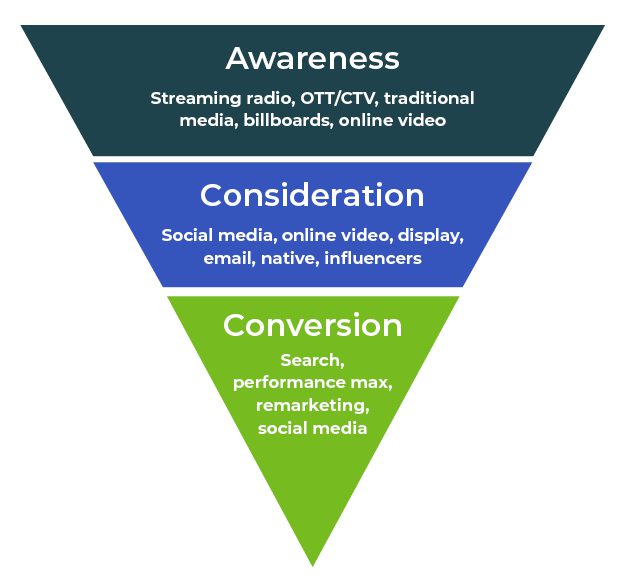
Not all campaigns accomplish the same thing. If the end goal of the campaign is awareness, but you’re using Google Search, then you’re going to have a very high CPM. Conversely, if you’re looking for people to start applications and you’re only using streaming radio, you are going to have a low CPM but a high CPA. This is why it’s critical to define what campaign success looks like before you start your media strategy.
Below are typical channels and tactics at different levels of the funnel—note that the space is so complex now and there are a lot of caveats, so this is a general guide.
Staying Focused
It’s so easy to get confused and distracted by seemingly good KPIs. Even if CPAs and CTRs are great, if they’re not translating to real results internally, then it’s time to re-evaluate the plan. Marketing is always about testing, learning, and adapting, and digital advertising is the epitome of this.
Need a partner to help? Want to learn more about digital advertising? We run campaigns and offer training! We’re happy to help.


